

On Tuesday afternoon, I walked into room SMB017 in the Stewart Mason Building at Loughborough University and looked out at a room full of final-year business students.
Loughborough is where I did my PhD. I once walked these same paths as a student, worrying about deadlines and wondering what the world of work would really look like. So standing at the front of that room as a guest lecturer meant more to me than I expected.
I was there at the invitation of Dr Olatorera Williams, who teaches the Part C module 26BSC071 Managing Big Data at Loughborough Business School. I called the session From Data to Decisions: cloud computing, data storage and analytics in the real world. I want to thank Dr Williams for opening the door, and for trusting me with an afternoon of his students’ time.
I started with a question
How many cloud services have you used since you woke up?
It sounds like an easy question until you try to answer it. The alarm on your phone. The music on the way in. The group chat. Your email. The lecture notes you opened before you sat down. Most of us use the cloud dozens of times before lunch without ever thinking about it.
That was my starting point. The cloud is not something far away in an IT department. It is already part of everyday life. The question for a business student is not whether organisations use it, but how they decide to use it well.
From a Loughborough lab to industry
I told the students a little about my own journey. A BSc in Systems Engineering at the University of Lagos. An MSc in Control Systems Engineering at Sheffield. Then a PhD in Multisensor Data Fusion, right there at Loughborough. After that, more than ten years of data and AI work in payments, banking, energy, infrastructure and the car industry.
There is one line on that slide I really believe. My PhD was about joining up messy data from many sources. Which, it turns out, is exactly what businesses ask the cloud to do.
One company, all the way through
Business students do not need another lecture full of acronyms. What they need is to understand why organisations make the technology decisions they make, and what those decisions cost when they go wrong.
So we followed one made-up company all the way through: a UK energy supplier with customers, bills, complaints and a board asking hard questions about money. Every idea we covered, we brought back to that company. What would this mean for them? Who would pay for it? Who would be affected if it went wrong?
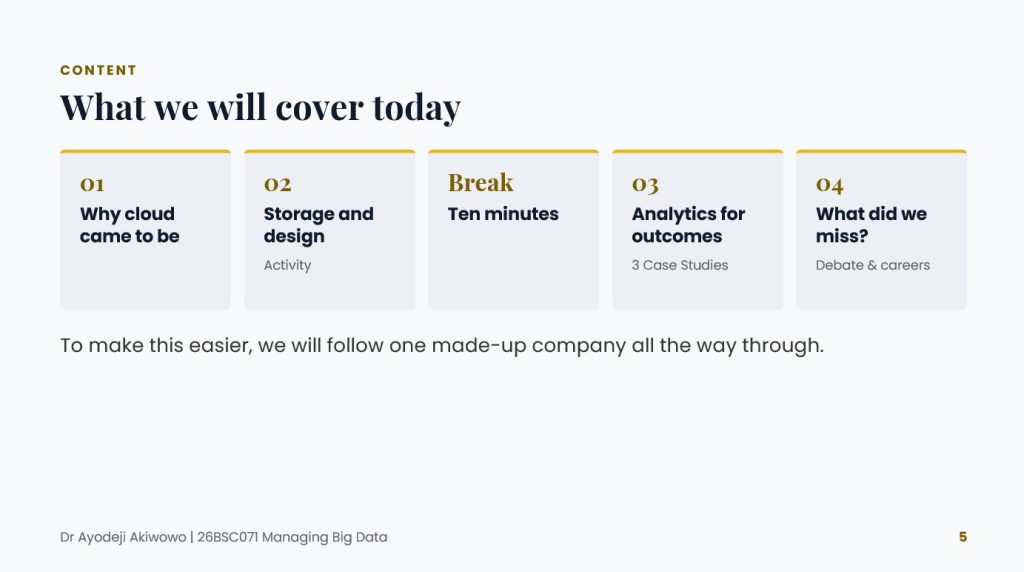
The afternoon had four parts: why the cloud came to be, storage and design, analytics for outcomes, and a final section I called “What did we miss?”, which became a debate and a conversation about careers.
Why the cloud came to be
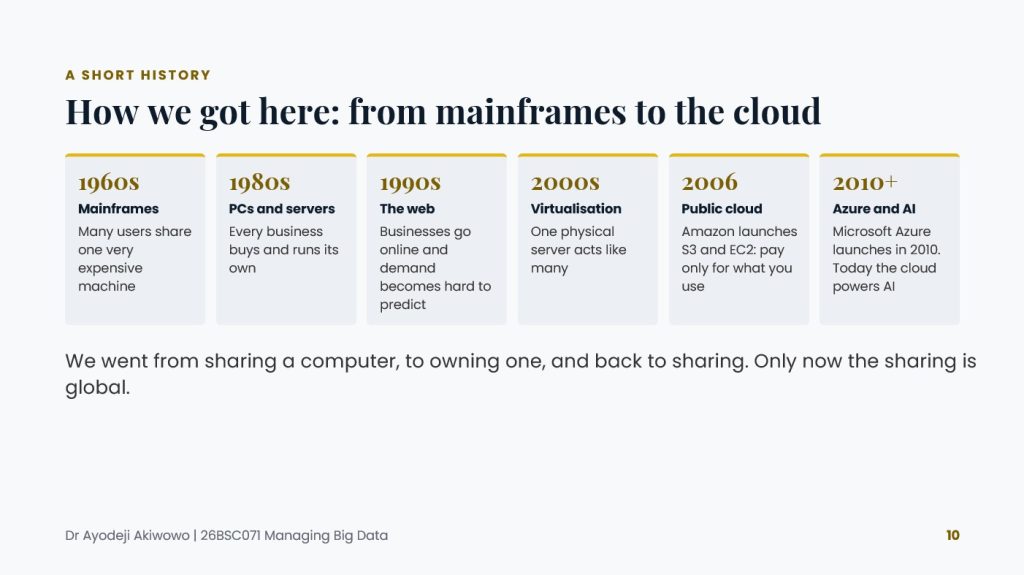
In the 1960s, many users shared one very expensive mainframe. By the 1980s, every business was buying and running its own PCs and servers. The web arrived in the 1990s and demand suddenly became hard to predict. In the 2000s, virtualisation let one physical server act like many. In 2006, Amazon launched S3 and EC2, and organisations could pay only for what they used. Microsoft Azure followed in 2010. Today, the cloud powers AI.
The way I summed it up for the students was this: we went from sharing a computer, to owning one, and back to sharing. Only now the sharing is global.
The cloud did not win because it was fashionable. It won because it changed the economics. Organisations stopped guessing how much capacity they would need and paying for that guess whether they used it or not.
Storage keeps getting smaller. The cloud keeps getting bigger.
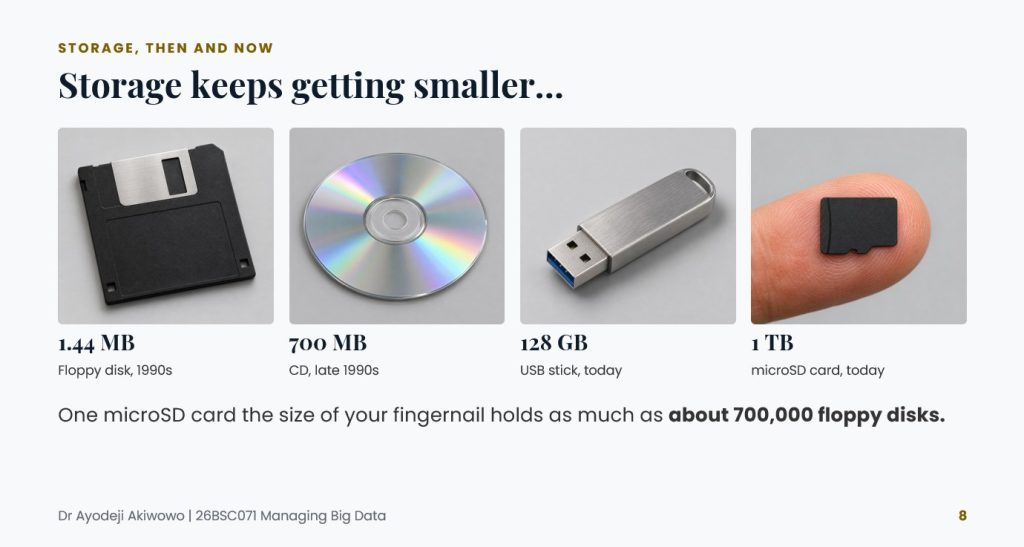
A floppy disk from the 1990s held 1.44 MB. A CD held 700 MB. A USB stick today holds 128 GB, and a microSD card the size of your fingernail holds 1 TB. That one tiny card holds as much as about 700,000 floppy disks.
Most students today have never used a floppy disk. That is exactly the point.
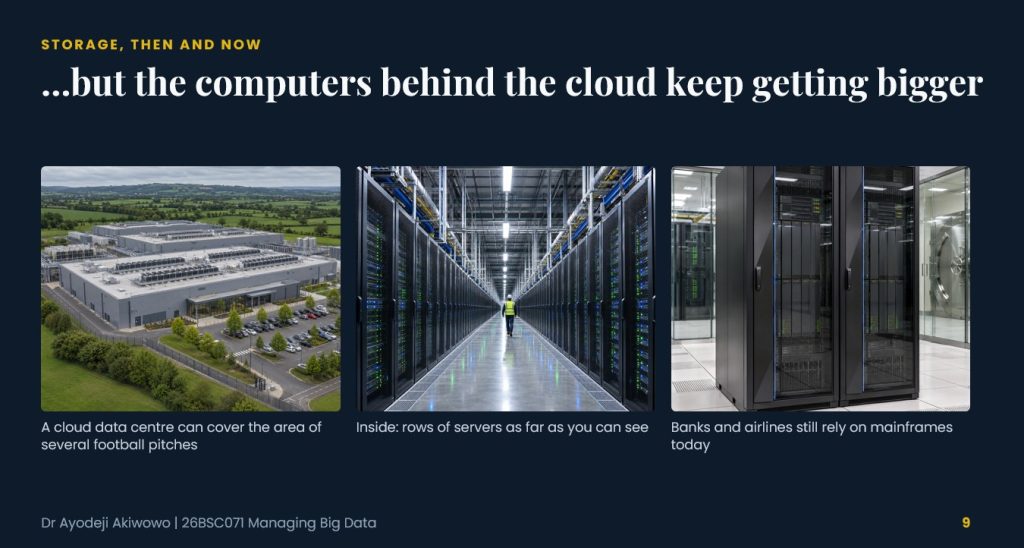
But here is the twist. While the devices in our pockets keep getting smaller, the computers behind the cloud keep getting bigger. A single cloud data centre can cover the area of several football pitches, with rows of servers as far as you can see. And many banks and airlines still rely on mainframes today.
Then we brought it back to our energy company. How you store data decides what questions you can answer later. If meter readings sit in one place, payments in another and complaints in a third, with no way of linking them, no amount of clever analytics will save you. The students worked through this in groups. Good design is a business decision long before it is a technical one.
“But what happens if the data centre goes down?”
Some of the best questions of the afternoon came from the students, and several of them circled around the same worry. If everything lives in the cloud, what happens if something happens to the data centre? A fire. A flood. A power cut. A cyber attack.
It is exactly the right question to ask, and it is the question every board should be asking too.
The honest answer is that a well-designed cloud system does not depend on one building. The big providers spread their services across separate data centres and separate regions, often in different parts of the country or the world. Your data can be copied to more than one location, so if one site fails, another can take over. Good organisations also keep backups, test that they can actually restore them, and plan in advance how quickly they need to be running again after something goes wrong.
But, and this is the part I wanted them to remember, none of that happens by magic. The cloud gives you the tools for resilience. Someone in the organisation still has to decide to use them, pay for them and test them. Moving to the cloud does not move the responsibility.
Analytics for outcomes
After a ten-minute break, we looked at analytics on Microsoft Azure through three case studies from my own industry work, anonymised. I do not name the organisations, but the lessons are real, and students can tell the difference between a textbook example and something that actually happened.
My point here was simple. A dashboard is only useful if it changes a decision. If nobody does anything differently because of it, it is decoration.
What did we miss?
I always try to stop talking at some point in a lecture. People learn more when they have to take a position themselves.
So we closed with a debate on responsible AI. Should our energy supplier use AI to predict which customers are likely to fall behind on their bills? What if it helps them offer support earlier? And what if it is used to treat those customers unfairly instead?
There is no easy answer, and that was the point. The same model can protect a vulnerable customer or harm one. The difference is not in the technology. It is in the people who decide how it is used.
I also used the opportunity to talk about AI ethics and what it really means to use data responsibly. For me, this is not an optional extra at the end of a technical lecture. It is the point.
Every row in our energy company’s database is a real person. A family on a prepayment meter. A pensioner worried about the winter. Someone who has just lost their job. Before we ask what we can do with their data, we should ask whether we should. Do we need it? Did they understand how it would be used? Would they be comfortable if they saw what we were doing with it?
Responsible data use starts with simple habits. Collect only what you need. Keep it secure. Be open about how it is used. Check your models for bias before they make decisions about people. And always keep a human being accountable for the outcome.
We finished by talking about careers: where these skills are needed, and how business graduates who understand data can be the people in the room who ask the right questions.
What I hope they took away
If those students remember one thing from Tuesday, I hope it is this: digital transformation is not really about technology. It is about people, decisions and trust. The cloud, the data platforms and the AI tools are just how we get from data to decisions.
Many of them will soon be in organisations making exactly these choices. I would like them to ask the hard questions, and to ask them with confidence.
Thank you again to Dr Williams and to Loughborough Business School for having me. Coming back to Loughborough always feels a little like coming home.
If you lead a module or a programme and would like an industry guest lecture on data, cloud or responsible AI, you can get in touch here.