

“Everyone says we should be using AI. Where do we even start?”
I hear some version of that question from charities, church groups, community organisations and small business owners all the time. And I understand it. You are already stretched. You have a small team, or a team of volunteers, and very little time. The last thing you need is another technology that promises the world and leaves you more confused than before.
So here is my honest answer. You do not need a big budget, an IT department or a strategy document. You need a simple plan, a few ground rules and the patience to start small.
This post is that plan.
First, what are we talking about?
When I say generative AI, I mean tools like ChatGPT, Microsoft Copilot, Google Gemini and Claude. You type a request in plain English, and they produce text, images or summaries. They can draft a newsletter, summarise meeting notes, turn rough ideas into a funding bid outline, or translate a flyer into another language.
Used well, they can give small organisations back hours every week. Used carelessly, they can leak personal data, publish mistakes under your name and repeat bias you would never knowingly accept. The difference is not the tool. It is how you bring it in.
The roadmap
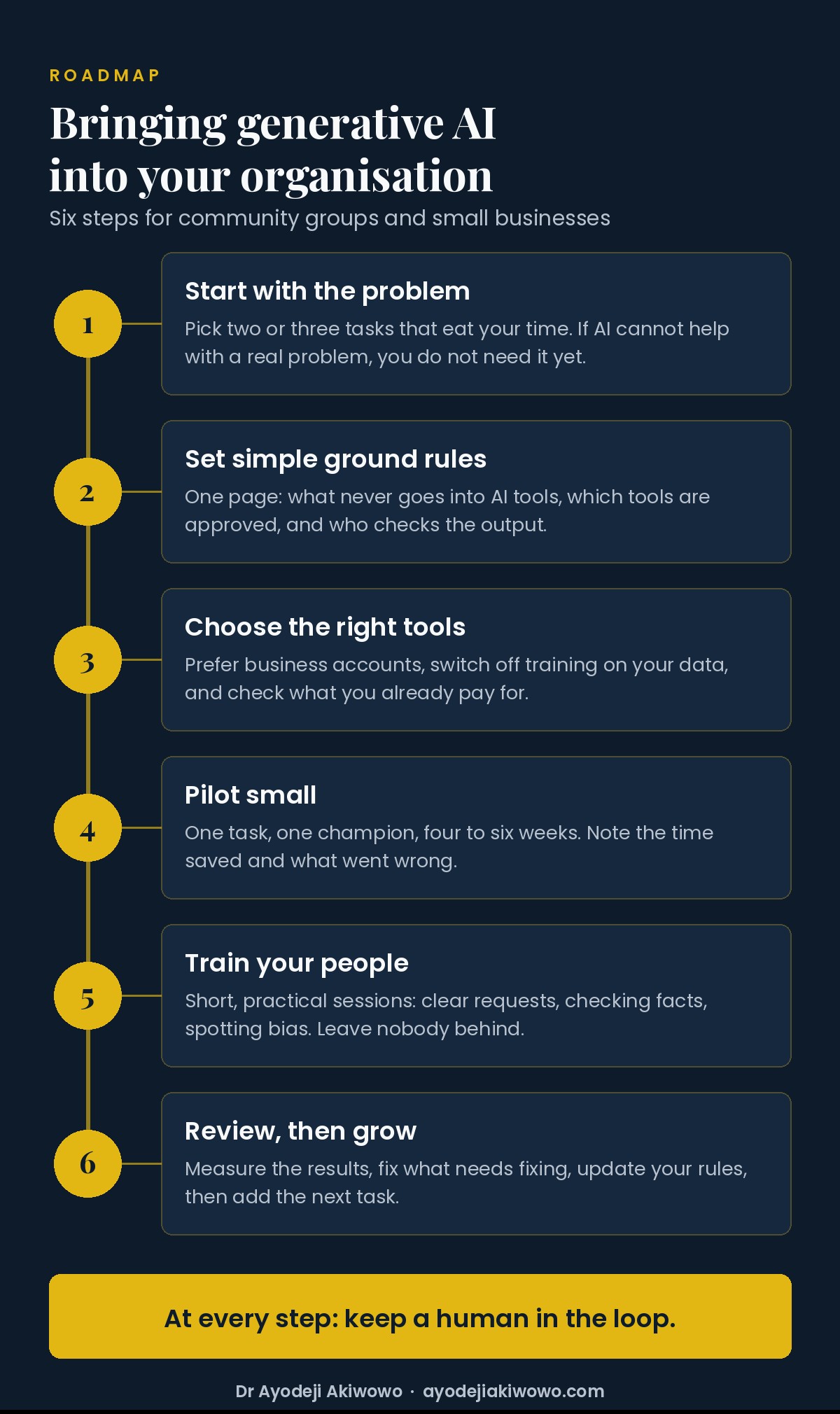
1. Start with the problem, not the tool
Do not start by asking which AI tool to buy. Start by asking where your time goes. Which tasks are repetitive, draining or always left until the last minute? Writing the weekly newsletter. Replying to the same enquiries. Turning meeting notes into actions. Drafting social media posts.
Pick two or three. Those are your starting points. If AI cannot help with a real problem you have, you do not need it yet.
2. Set simple ground rules
Before anyone starts using AI for work, agree a few rules and write them down. One page is enough. You do not need a 200-page policy.
- What must never go into an AI tool? Personal details, safeguarding notes, health information, financial records, anything confidential.
- Which tools are we allowed to use?
- Who checks the output before it goes out?
- What do we do if someone makes a mistake?
If you want to understand why this matters, I wrote about it in how to use AI tools without giving away your business secrets.
3. Choose the right tools
Free tools are tempting, but if a tool is free, you are very often the product. Where you can, use business or team accounts, which usually promise not to train on your data. If you use a personal account, switch off the setting that lets your conversations be used for training.
Also check what you already pay for. Many organisations already have Microsoft 365 or Google Workspace, which may include AI features. The best tool is often the one that fits the way you already work.
4. Pilot small
Choose one task and one person to lead it, your AI champion. Try it for four to six weeks. Keep simple notes. How long did the task take before? How long does it take now? Was the quality good enough? What went wrong?
Small pilots are low risk. If it does not work, you have lost very little and learned a lot.
5. Train your people
Most problems with AI are not technical. They are about people not knowing how to use it well. A short, practical session can make a huge difference. Show people how to write a clear request, how to check facts, how to spot when the tool is confidently wrong, and how to notice bias in what it produces.
And include your volunteers and older members. Nobody should feel left behind.
6. Review, then grow
At the end of the pilot, sit down and look honestly at what happened. Did it save time? Did it improve the work? Were there any risks or near misses? Fix what needs fixing, update your ground rules, and only then add the next task.
Growing slowly is not a weakness. It is how you build something that lasts.
Keep a human in the loop
Across every step, one rule does not change. A person stays responsible. AI can draft, summarise and suggest. It should not have the final word on anything that affects people’s lives, your reputation or your money.
Three mistakes I see often
Pasting in personal data. It feels quick and harmless. It is neither. Use initials, made-up examples or general descriptions instead.
Trusting the output without checking. Generative AI can sound completely sure of itself and still be wrong. Check names, dates, figures and anything that will be published.
Buying the tool before knowing the problem. If you cannot say what you want AI to help with, a new subscription will not fix that.
The point of all this
For community groups and small businesses, the real promise of AI is not replacing people. It is giving people their time back, so they can spend more of it on the work that only humans can do: listening, caring, building relationships and serving their communities well.
Start small. Set your rules. Keep a human in the loop. You do not have to get it perfect. You just have to start well.
If you would like more practical guidance, The Responsible AI Handbook is written for small business and charity leaders. And if your organisation would like help putting this roadmap into practice, you can get in touch here.